Chosen text from the reading list:
Barthes, RB. (1977) Image, music, text, London: Fontana.
Chosen excerpt of the text:
“The removal of the Author (one could talk here with Brecht of a veritable ‘distancing’, the Author diminishing like a figurine at the far end of the literary stage) is not merely an historical fact or an act of writing; it utterly transforms the modem text (or – which is the same thing – the text is henceforth made and read in such a way that at all its levels the author is absent). The temporality is different. The Author, when believed in, is always conceived of as the past of his own book: book and author stand automatically on a single line divided into a before and an after. The Author is thought to nourish the book, which is to say that he exists before it, thinks, suffers, lives for it, is in the same relation of antecedence to his work as a father to his child. In complete contrast, the modem scriptor is born simultaneously with the text, is in no way equipped with a being preceding or exceeding the writing, is not the subject with the book as predicate; there is no other time than that of the enunciation and every text is eternally written here and now. The fact is (or, it follows) that writing can no longer designate an operation of recording, notation, representation, ‘depiction* (as the Classics would say); rather, it designates exactly what linguists, referring to Oxford philosophy, call a performative, a rare verbal form (exclusively given in the first person and in the present tense) in which the enunciation has no other content (contains no other proposition)than the act by which it is uttered – something like the I declare of kings or the I sing of very ancient poets. Having buried the Author, the modem scriptor can thus no longer believe, as according to the pathetic view of his predecessors, that this hand is too slow for his thought or passion and that consequently, making a law of necessity, he must emphasise this delay and indefinitely ‘polish’ his form. For him, on the contrary, the hand, cut off from any voice, borne by a pure gesture of inscription (and not of expression), traces a field without origin – or which, at least, has no other origin than language itself, language which ceaselessly calls into question all origins.”
Summary:
Barthes says that the author is no longer the one who gives a text its meaning. Instead, meaning is created while the text is being written and read. Writing isn’t about expressing the writer’s personal thoughts or feelings, it’s about using language to create meaning as it happens. This means that the reader and the language itself, not the author’s intentions, are what shape how we understand a text.
My approach:
“Writing is something that creates meaning in the moment through language itself.”
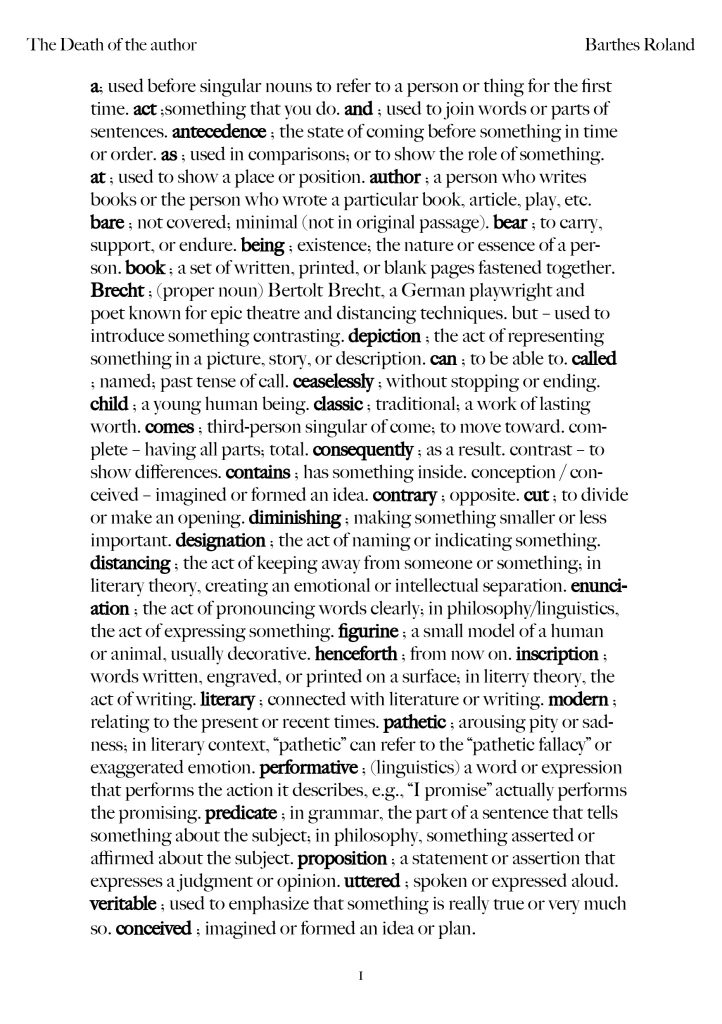
This quote made me wonder: Can a definition give enough meaning to a word? Or is it the way it is written? I created a list with all the definitions of some words used in the selected text to see whether form and the meaning of the defenition are enough to give value to a word. The answer is probably no. It needs context from other words to give meaning. The form of the revised text is a return to the format and design of a book. This is because the original format of the text is also like this and because the main theme of the text is about writers and their influence on the meaning of words in a text or story.
Leave a Reply