Methods of translating
WEEK 2
At the core of their work is the willingness to challenge imposed values and norms, and a search for freedom.
Many surrealist artists have used automatic drawing or writing to unlock ideas and images from their unconscious minds. Others have wanted to depict dream worlds or hidden psychological tensions. Surrealist artists have also drawn inspiration from mysticism, ancient cultures and Indigenous art and knowledges as a way of imagining alternative realities.
Symbolism plays a key role in surrealism, as it helps to express deep, often hidden meanings and emotions.
1. Dream and Subconscious
- Dreams: Surrealist paintings often evoke dreamlike scenarios where the boundaries between reality and fiction are blurred. A dream symbolizes the unlimited freedom of imagination and subconscious desires.
- Subconscious: Freudian theories of the subconscious had a significant influence on surrealists. In their works, symbols often reflect repressed emotions and fears.
2. Metamorphosis and Transformation
- Changing Forms: It’s common to see paintings where objects or beings undergo metamorphosis, changing shapes or merging into illogical forms. This symbolizes the variability of reality and the ambiguity of meanings.
- Human Body: Often depicted in a distorted way, it symbolizes anxieties related to identity, sexuality, and death.
3. Images of Duality
- Mirrors and Reflections: Mirrors often appear as symbols of duality and introspection. They can represent alternate realities or the artist’s inner self.
- Light and Darkness: The contrast between light and darkness can symbolize the struggle between consciousness and the subconscious, good and evil, reality and illusion.
4. Everyday Objects in a New Context
- Strange Juxtapositions: Everyday objects presented in unexpected contexts take on new, symbolic meanings. An example is René Magritte’s famous painting “Ceci n’est pas une pipe” (This is not a pipe), where the depiction of an object contradicts its name.
- Clocks: In Salvador Dalí’s works, particularly in “The Persistence of Memory,” melting clocks symbolize the fluidity of time and its subjective nature.
5. Surrealist Landscapes
- Deserts: Deserts and barren landscapes can symbolize emotional emptiness, isolation, or the landscape of an unconstrained mind.
- Seaside Sceneries: Often appearing in Dalí’s works, they symbolize deep introspection and journeys into one’s consciousness.
6. Animals as Symbols
- Insects: Motifs of insects like ants or butterflies can symbolize the inevitability of death (ants) or transformation (butterflies).
- Birds: They can symbolize freedom, but also the anxiety associated with the flight of thoughts and dreams.
7. Religious and Mythological Elements
- Cross: In surrealist works, the cross can have various meanings—from a symbol of suffering to a metaphor for death and rebirth.
- Mythological Figures: Figures like the Minotaur, which appear in Max Ernst’s works, symbolize the conflict between humanity and bestiality.
8. Automatism and Spontaneity
- Doodles and Abstractions: Unrestrained brush strokes or uncontrolled drawings are meant to symbolize the free flow of thoughts and the lack of censorship in the conscious mind.
Surrealism explores the depths of the human mind, using symbolism that is often ambiguous and open to interpretation. As a result, each painting can be perceived in different ways, depending on the viewer’s personal experiences and associations.
Teleurgesteld in het rationalisme, dat door de gruwelen van de Eerste Wereldoorlog te optimistisch was gebleken,
Andere technieken die gebruikt worden om inspiratie op te doen uit het onderbewuste zijn:[3]
Cadavre exquis – meerdere mensen werken samen aan een tekst of aan een beeld. In geval van een tekening op papier werken ze om de beurt aan een tekening, waarbij het werk van de eerder persoon wordt omgevouwen. Zo ontstaan vreemde figuren uitgevoerd in verschillende handschriften of stijlen.
Collage – door uitknippen en opplakken van niet met elkaar samenhangende beelden worden nieuwe, niet bestaande, voorwerpen gemaakt.
Decalcomanie – verf of inkt op een papier wordt overgebracht op een ander papier, waardoor grillige afbeeldingen ontstaan.
Frottage – een papier wordt op een ondergrond met een structuur gelegd, met potlood wordt over het papier gewreven, zodat de structuur zichtbaar wordt. Grattage is een variant hiervan, waarbij een structuur onder een nog nat schilderwerk wordt gelegd. Met een paletmes wordt de natte verf afgeschraapt, zodat de structuur zichtbaar wordt.
Oscillatietechniek – een blik verf met een gat in de bodem wordt boven het schildersdoek aan een draad gehangen en heen en weer geslingerd. Zo ontstaan lijnen en druppels die de vorm aannemen van lissajousfiguren.
Dalí begon zijn eigen angsten en fantasieën te verkennen en legde deze door symbolische beelden op doek vast in een ultrarealistische, fotografische stijl. Hij verwees naar deze schilderijen als ‘handgeschilderde droomfoto’s’.
René Magritte:
“Magritte had established his style: he claimed would shock visitors by obliging them to re-think their thoughts by the unexpected juxtaposition of the objects.”
“Finding mysteries in the objects all arounds us”
During these years and beyond, Magritte defined his unique artistic style that critics called “Magic realism.” Throughout his long career, he produced paintings that blurred the line between reality and fantasy and invited the viewer to question what they thought they knew
By scrounging these objects from reality and restoring them in a field outside of their power, he gave the object (product, signifier) a new context.
The Surrealists in Brussels advocated for a mental form of painting, focusing on dialectics and science, while those in Paris sought a more psychic creation drawn from the unconscious.
The ambiguity of its role in the present scene invites the viewer to contemplate possible interpretations without ever offering a definitive meaning, sustaining a sense of enigma that the painter prized above all else.
For Magritte, the apple came to symbolize this perpetual tension between the hidden and visible, and he even used it to obscure his own visage in some of his self-portraits.
The painter stated:
Those of my pictures that show very familiar objects, an apple, for example, pose questions. We no longer understand when we look at an apple; its mysterious quality has thus been evoked. In a recent painting, I have shown an apple in front of a person’s face At least it partially hides the face. Well then, here we have the apparent visible, the apple, hiding the hidden visible, the person’s face. This process occurs endlessly. Each thing we see hides another, we always want to see what is being hidden by what we see. There is an interest in what is hidden and what the visible does not show us. This interest can take the form of a fairly intense feeling, a kind of contest, I could say, between the hidden visible and apparent visible”. Suzi Gablik suggests that “Magritte’s paintings are a systematic attempt to disrupt any dogmatic view of the physical world. By means of the interference of conceptual paradox, he causes ordinary phenomena to inherit extraordinary and improbably conclusions. What happens in Magritte’s paintings is, roughly speaking, the opposite of what the trained mind is accustomed to expect. His pictures disturb the elaborate compromise that exists between the mind and life. In Magritte’s paintings, the world’s haphazard state of consciousness is transformed into a single will”
Magritte would ultimately break with Andre Breton, the founder of the Surrealist school. Magritte’s work primarily addressed the issue of representation in the work of art. Magritte seems to suggest that no matter how realistically the artist can depict an item, verisimilitude is still an artistic strategy, a mere representation of the thing, not the thing itself.
Magritte’s work invites viewers to question reality, perception, and meaning. With his characteristic blend of wit, mystery, and illusion, he helped shape the visual and philosophical language of the Surrealist movement and remains one of its most recognisable figures.
juxtapose everyday objects in unexpected contexts
Lucid dreams
Paul Tholey laid the epistemological basis for the research of lucid dreams, proposing seven different conditions of clarity that a dream must fulfill to be defined as a lucid dream:
Awareness of the dream state (orientation)
Awareness of the capacity to make decisions
Awareness of memory functions
Awareness of self
Awareness of the dream environment
Awareness of the meaning of the dream
Awareness of concentration and focus (the subjective clarity of that state)
Later, in 1992, a study by Deirdre Barrett examined whether lucid dreams contained four “corollaries” of lucidity:
The dreamer is aware that they are dreaming
They are aware that actions will not carry over after waking
Physical laws need not apply in the dream
The dreamer has a clear memory of the waking world
You might also be wondering if you could somehow capture these elusive moments. The inventor Thomas Edison and the artist Salvador Dalí reportedly did just that, setting traps to capture their hypnagogia, aiming to seize these putative flashes of creativity before they vanished into the limbo of sleep. Their secret? Taking naps while holding an object that dropped noisily as they dozed off, to awaken them just in time to record novel ideas.
Hypnagogia is the transitional state from wakefulness to sleep, also defined as the waning state of consciousness during the onset of sleep. Its corresponding state is hypnopompia – sleep to wakefulness. Mental phenomena that may occur during this “threshold consciousness” include hallucinations, lucid dreaming, and sleep paralysis.
Transition to and from sleep may be attended by a wide variety of sensory experiences. These can occur in any modality, individually or combined, and range from the vague and barely perceptible to vivid hallucinations.
A hallucination is a perception in the absence of an external context stimulus that has the compelling sense of reality.[6] They are distinguishable from several related phenomena, such as dreaming (REM sleep), which does not involve wakefulness; pseudohallucination, which does not mimic real perception, and is accurately perceived as unreal; illusion, which involves distorted or misinterpreted real perception; and mental imagery, which does not mimic real perception, and is under voluntary control.[7] Hallucinations also differ from “delusional perceptions”, in which a correctly sensed and interpreted stimulus (i.e., a real perception) is given some additional significance.
Experiments
- Encomperate modern objects in to paintings from magritte
- Combine certain elements from magritte but with modern objects
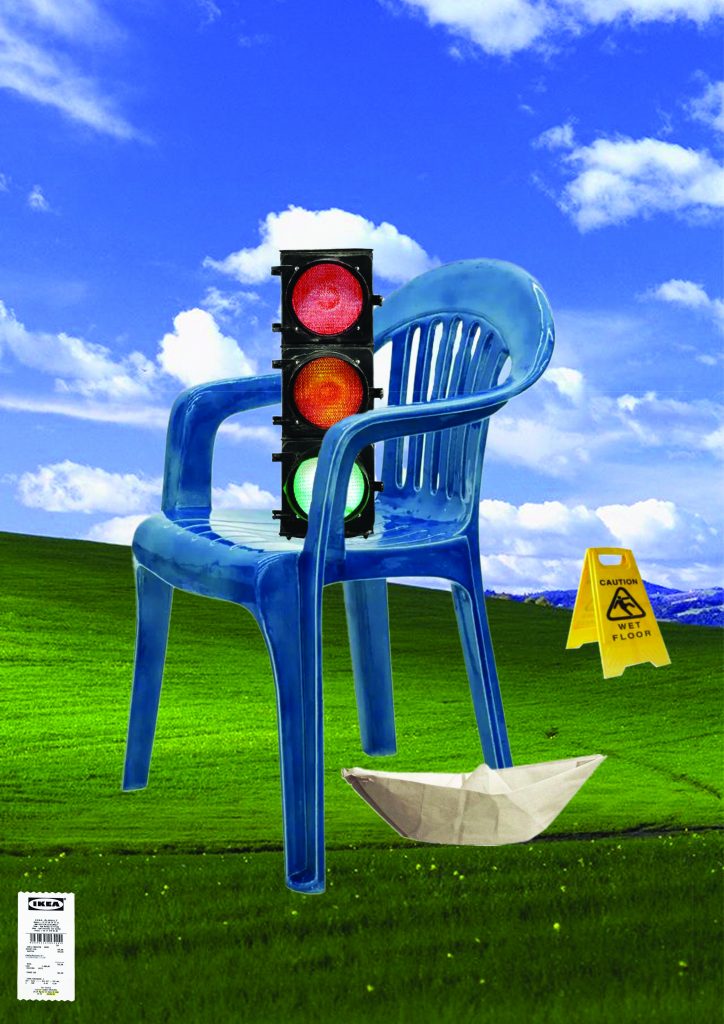
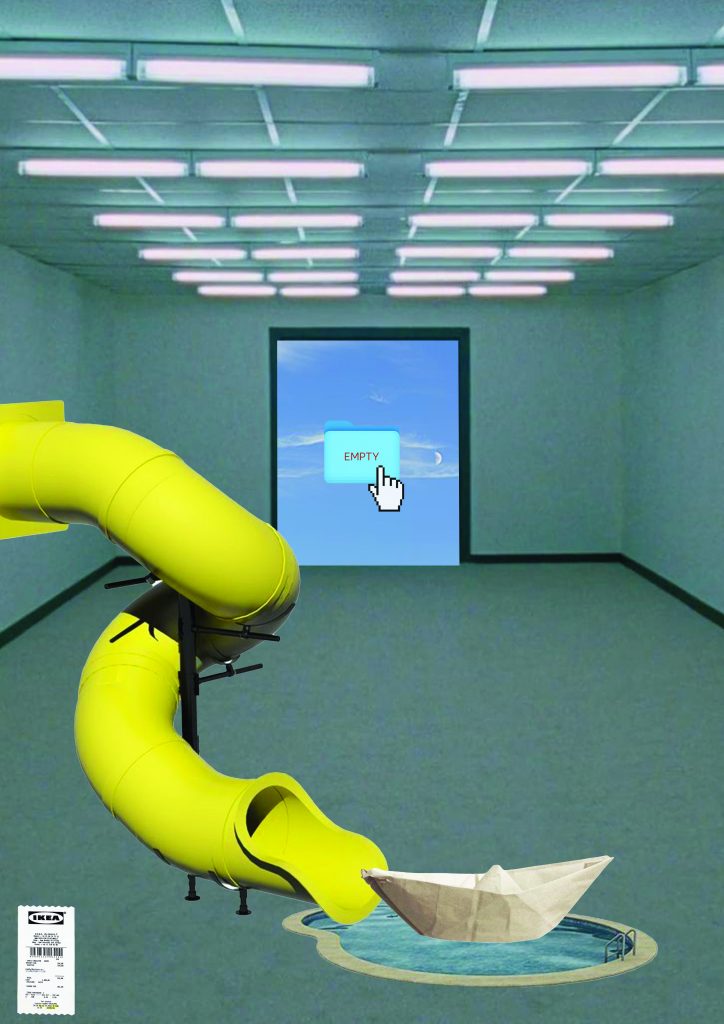
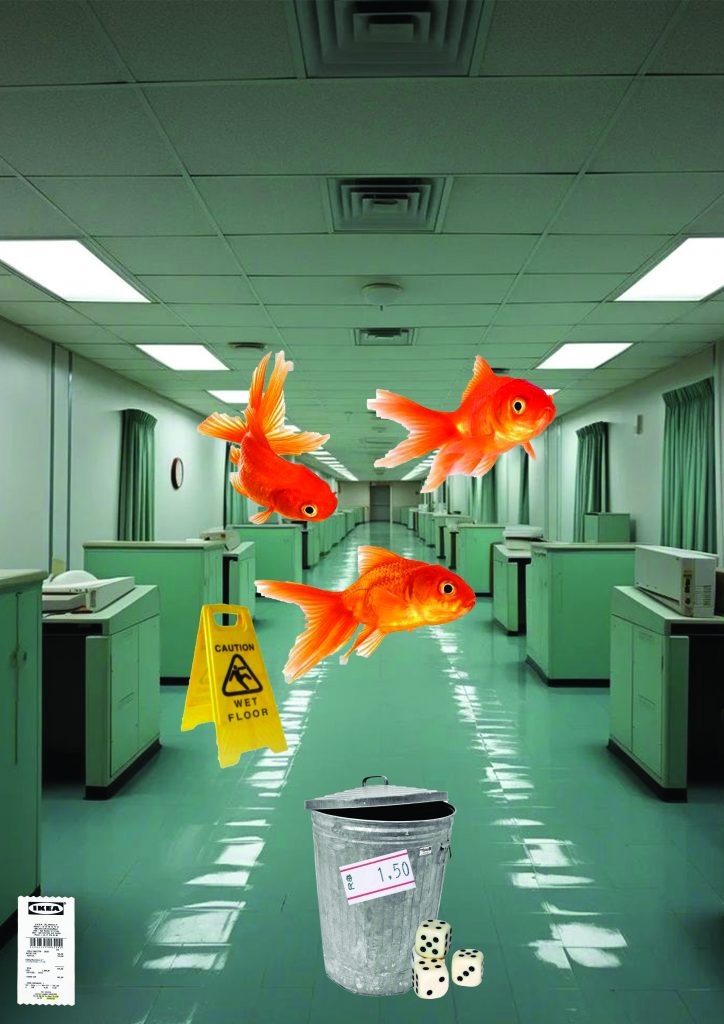
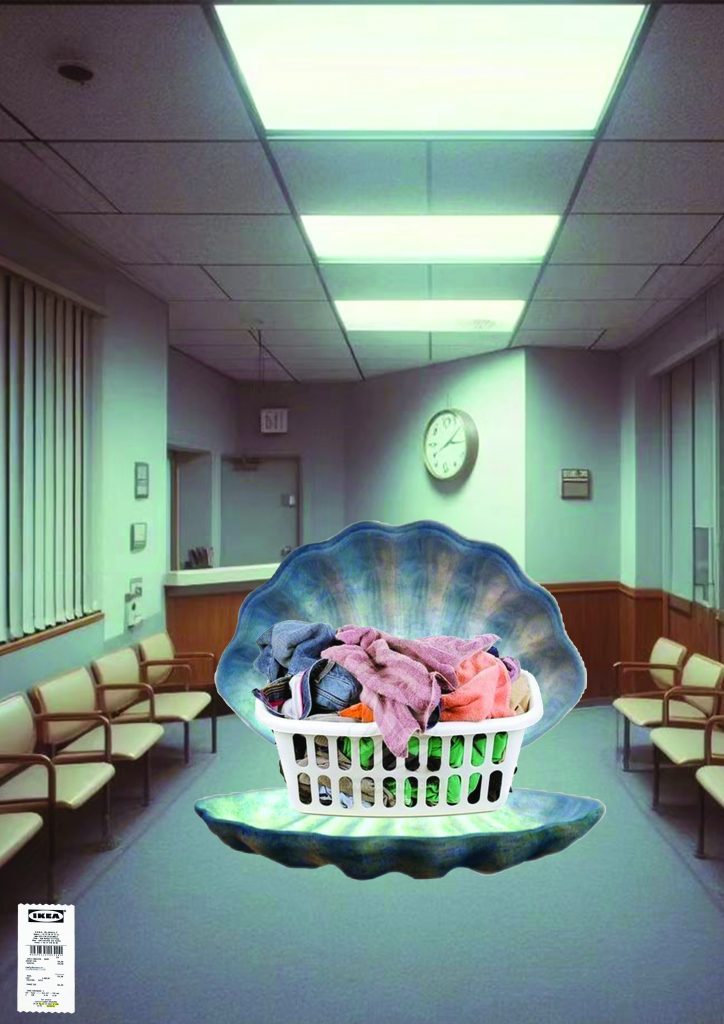
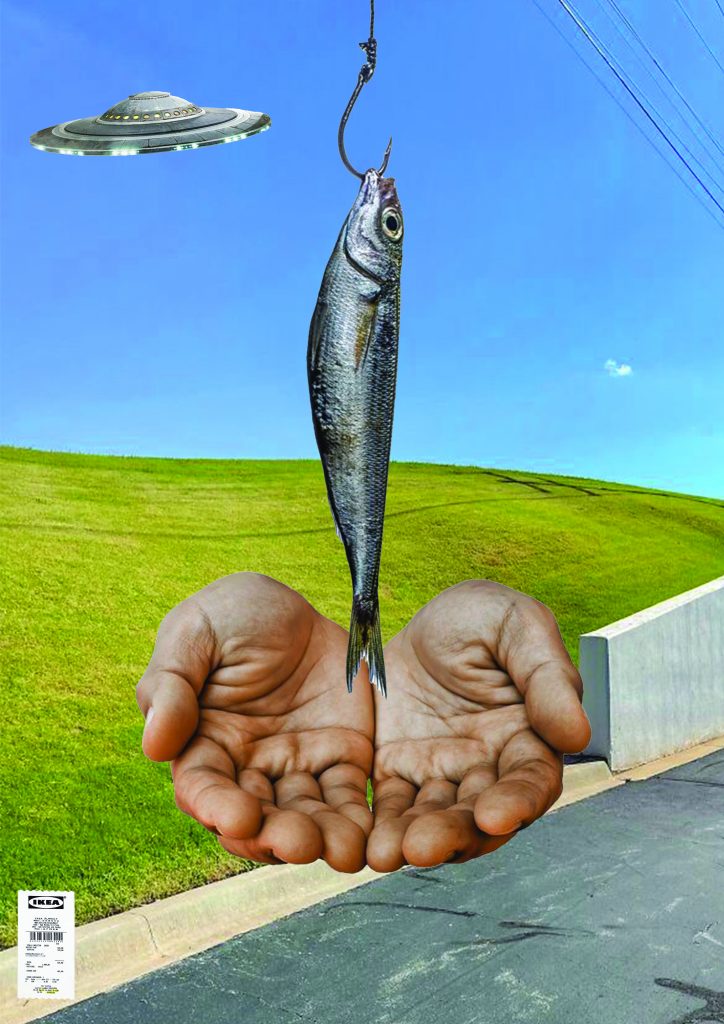
How can everyday objects become a story by building another world with them. I juxtapose everyday objects in unexpected contexts imaging where the consiuous and subconsiuous mind travel to another world. And to see how their meaning changes when placed next to each other
Surrealism explores the depths of the human mind, using symbolism that is often ambiguous and open to interpretation. As a result, each painting can be perceived in different ways, depending on the viewer’s personal experiences and associations.
Leave a Reply