Draft 1
While you’re working on your copy, articulate (in writing) the key critical questions that emerge through this exploration. (You can use the prompts found on the first page of this brief as a guide.) Discuss how the project that you’re copying raises these questions and write a proposal for a studio-based experiment that would allow you to explore them further. Bring this first draft to your tutorial on Jan 23. (Word count: approx. 200)
I tried to navigate myself through the program without really watching that many tutorials. So, I could really explore it on my own. I felt like a lot the tutorial were showing a lot of different ways to do the same thing. It really made me wonder why there are so many ways of doing the exact same thing through different shortcuts or panels. I wanted to figure out what were my personals ways of using the program, but I feel like I’m only using the same tools in the program to make my shapes etc. I also feel that this program uses a different way in thinking about how shapes are made of. I in a way it feels limited for me to really explore the program freely because I’m constantly rethinking how shape work and how it works in 3d. Why can I only follow the logic of the program?
What’s unexpected about this thing you just made?
I thought that it would be easier to just copy the shapes of the project, but it made me change the way I see shapes because you really need to think in 3d and see what shapes build the object you’re making.
What do you understand better or differently about your tool or
medium now? Did it pose a particular technical challenge?
It was a challenge not just to learn how the program works but really unfold the way 3d objects work. Which I get because it’s a 3d building program but it makes me realise that building something in 3d need a different kind of knowledge to really use the tool in the ultimate way. Although I sometimes feel there could be an easier way to put things in different panels viewports. It feels sometimes really overwhelming to start searching for the tools.
What kind of output or knowledge does this tool or medium favor? What relationship does it have to graphic or communication design?
I feel like you can really create your own design in the program. If you want to make a drawing or creating come to live. It really makes you build your own world, which is really nice, but I feel like you can only use it to the max if you really understand the program. If you just begin to get to know the program it can feel sometimes a bit limited
In Blender you can really create your own fantasy world. And create a world of your own without the purpose of being used of to put it out there. How can you create something freely and new without the skill?
Draft 2
Identify a reference from the reading list that you can use as a lens through which to view and analyse your project. Then create a second draft of your writing that advances your enquiry in response to this new context. Bring this second draft to your tutorial on Jan 30. (Word count: approx. 400–500)
Coeckelbergh, M. Can Machines Create Art?. Philos. Technol. 30, 285–303 (2017). https://doi.org/10.1007/s13347-016-0231-5
Creating your own fantasy world takes a certain skill in blender. Can we really create our own imaginary world into this software. How can we compare this to the use of AI to create our own fantasy world. Another tool that is built for creating this in your own way. Both using computers to create something. But there is a difference in creating. One is used to have the ability to shape your own world, the other one is used for creating without the ability. But what happens if you haven’t got the skills for using blender. Can you really create whatever you want? Or are you limited by the knowledge of the program and you adapt your world to the level of kill you have? Using AI can be another way to create your own things. With the right prompt it can create a single outcome in a few seconds. But can AI be imaginative? Can it really create something new that matches the way you imagined your work. And how would that outcome be compared to the ones made in blender. You can learn skills to work with blender with time and patients and I think for 3d worldbuilding it can be the most accessible to use because it is free. Most Ai tools to create 3d models are limited of use and have required subscription. Building your own fantasy requires a lot of imaginaries. Most of the times when you recreate something creative from your own mind is
“Can machines create art?” This a question that comes to mind if we think about the use of AI in a creative context. “A different way to understand the question regarding machines and art is to focus on the outcome and ask, is what the machine creates, the artistic product, the work of art, really a work of ‘art’? Is machine art really art?”
New reference from reading list: ANDREW BLAUVELT, LUNA MAURER, EDO PAULUS, JONATHAN PUCKEY, AND ROEL WOUTERS
Conditional Design Workbook
Amsterdam: Valiz
2013
Excerpt pp. ii–xiv
Draft 3
For the third draft of your written response, render your text using the tool or medium that you’ve been exploring during this project. This is both a visual and intellectual exercise. How does the text and its meaning change when you translate it in this way? Bring this third draft to your tutorial on Feb 6.
Set up these drafts in a single document, with each new draft appearing below the previous one so they can be easily compared.
The tool I’ve chosen to learn and explore is Blender. It is a free open source 3d computer graphic software. It can be used for modelling, piping, animation, rendering, simulation, motion tacking etc. One of their key uses is 3d modelling and sculpting. With the tools you can make your own complex objects and characters from basic shapes. For my enquiry I focus on these tools as they are the first steps to worldbuilding before adding texture and other details. But what happens if you haven’t got the skills for using Blender, can worldbuilding really be achieved if you don’t have the skill to work with the software? And how accessible is learning a new skill.
To start my enquiry, I chose to copy Fantasy Teapot (2023) by the artist Kikimori. This is a 3D model of a teapot inspired by Sandara Tang’s concept art. It was made entirely in Blender. I first tried to make the teapot without watching any tutorial. To see how I can navigate through the tool and see how accessible I can really be if I went into it without this basic knowledge. It was easy to add the basic shapes and work with the first tools that I found. But when it came down to create more complex shapes or to try to make the shaped as accurate as possible it became more challenging, so I started to watch different tutorials to help me navigate my way throughout the different panels and portals of the software for modelling and sculpting. In my first observations and attempts of using the software it became clear that blender is harder to use when the shapes you want to create don’t originate with the basic shapes from the toolbox. You can use a pen tool in the edit mode, but it is harder to make it 3D and perfect align with the different perspectives. By repeating the creation process several times, it became clear that it was becoming easier to create my shapes based on the teapot more accurately. However, I still found that I kept encountering the same obstacles and was unable to find a solution to overcome them. The software offers many ways to do certain things with the same result. So, the easiest way to create things is based on personal preference of settings. Is Blender user-friendly, or do these different ways make it more difficult for the user? Arguably, it’s a combination of both. Blender is an accessible programme if you want to learn more about 3D world building, but for complex things, it quickly requires a high level of knowledge and skill.
How can we compare this to the use of AI for worldbuilding? Both tools can be used for worldbuilding. But both requires a different skill set. Using AI can be an easier and faster way to worldbuilding as it doesn’t require a skill to create your object form scratch in a new software. But the quality will maybe not be as nice as building it your own in blender. There is free site that can be used for easy access to worldbuilding but most of the website are limited in attempts to create. The most challenging part of using AI to build your own world is finding the right prompt to translate your vision into your worldbuilding.
I wanted to compare both AI and Blender to the use of a subscripted software to see how accessible this would be as a subscripted software. Adobe illustrator has a 3d and materials feature that allows users to create 3D shapes in various materials. Although it is a software primarily used for 2d worldbuilding it is interesting to see how accessible and how accurate it would be. The use of the pen tool makes it more accessible to create more complex shapes into 3d. But only your object/shape consist of that one shape. If you would try to make more shapes into one, it becomes more challenging. Because each object had its own lighting so it’s more difficult to render multiple objects into one. The only thing that is advanced is the access to the material library online, where you can synchronise the martials directly to your illustrator. All of this made me question the program because a free program such as blender is more powerful to create than a subscripted one. Easy to make basis 3d. There is no 360-view port. The objects look like there are 3d but there is still an 2d aspect that feels like it’s unreal.
Each of the software’s had their limitations, which makes me wonder if there is such thing as the perfect tool. A tool where you can create freely, easy and where the outcome is aligned with the mind instead of the skill to use the machines to create something. Is the only way to create linked with skill and ability. Is the concept more important or the outcome? Does the skill make the designer or the concept behind it.
In ‘Ghost in the machine: distributing subjectivity’ Andrew Blauvelt reacts to the condition design manifesto. The main premise of the manifesto is that the process is the product. They introduce conditional design as a new term that focusses on the approach instead of the chosen media. “We conduct our activities using methods of philosophers, engineers, inventors and mystics.” This quotes from the manifesto uses Andrew B. to connect with the manifesto of Sol LeWitt. He would remark that if the machine makes the art, who makes the idea. The idea is the machine makes the art. This means that conceiving and articulating an idea are more important than the technical execution or the medium. Conditional Design shares this vision by stating that the process is the product. This statement is relevant to my research of this brief. In which I’m debating which is more important; the medium or the idea in worldbuilding. And how can we create freely if we don’t have the skill to do it. Andrew B also talks about letting go of the control in design. This is interesting because if we use a tool such as AI we don’t really have the ultimate control on the outcome. We can put in the prompt and chance it, but eventually it’s up to AI what to create with the text you’ve put into it. But with blender it’s a bit different. We have control over the tool it gives us. But if we wanted to create something different that blender doesn’t have the tools for it, we are limited as designers to really create our art.
Final version
The tool I’ve chosen explore is Blender. It is a free open source 3d computer graphic software. One of the main applications I am focusing on in this enquiry is 3D modelling and sculpting. I want to investigate what happens if you haven’t got the skills for using Blender, can worldbuilding really be achieved if you don’t have the skill to work with the software?
To start my enquiry, I chose to copy Fantasy Teapot (2023) by the artist Kikimori. This is
a 3D model of a teapot inspired by Sandara Tang’s concept art. In my first attempts of using the software it became clear that blender is harder to use when the shapes you want to create don’t originate with the basic shapes from the toolbox. After a while, it was becoming easier to create more accurately. How ever, I still found that I kept encountering the same obstacles. Blender is an accessible programme if you want to learn 3D world building, but for complex things, it quickly requires a high level of knowledge and skill.
How can I compare blender to other tools for worldbuilding. Using AI can be an easier and faster way for worldbuilding as it doesn’t require any skill. The most challenging part of using AI for worldbuilding is finding the right prompt to visualise your idea. I wanted to compare both AI and Blender to the use of Adobe Illustrator. The objects look like there are 3D but there is still an 2D aspect that feels like it’s unreal. Each of the software’s had their limitations, which makes me wonder if there is such thing as the perfect tool. A tool where you can create freely, and where the outcome is aligned with the mind instead of the skill to use the machines to create something.
In ‘Ghost in the machine: distributing subjectivity’ Andrew Blauvelt reacts to the condition design manifesto. They introduce conditional design as a new term that focusses on the approach instead of the chosen media. Andrew B. connects some of their ideas with the manifesto of Sol LeWitt. Where Sol LeWitt would question that if the machine makes the art, who makes the idea. This means that conceiving and articulating an idea are more important than the technical execution or the medium. This statement is relevant to my research. In which I’m debating which is more important: the medium or the idea in worldbuilding. And how can we create freely if we don’t have the skill to do it. Andrew B also talks about letting go of the control in design. This is interesting because if we use a tool such as AI, we don’t really have the ultimate control on the outcome. It’s up to AI what to create with the text you’ve put into it. But with blender it’s a bit different. We have control over the tool it gives us. But if we wanted to create something different that blender doesn’t have the tools for it, we are limited as designers to really create our art. Does the skill make the designer or the concept behind it.
Bibliography:
Maurer, L (2013) Conditional design workbook, Valiz
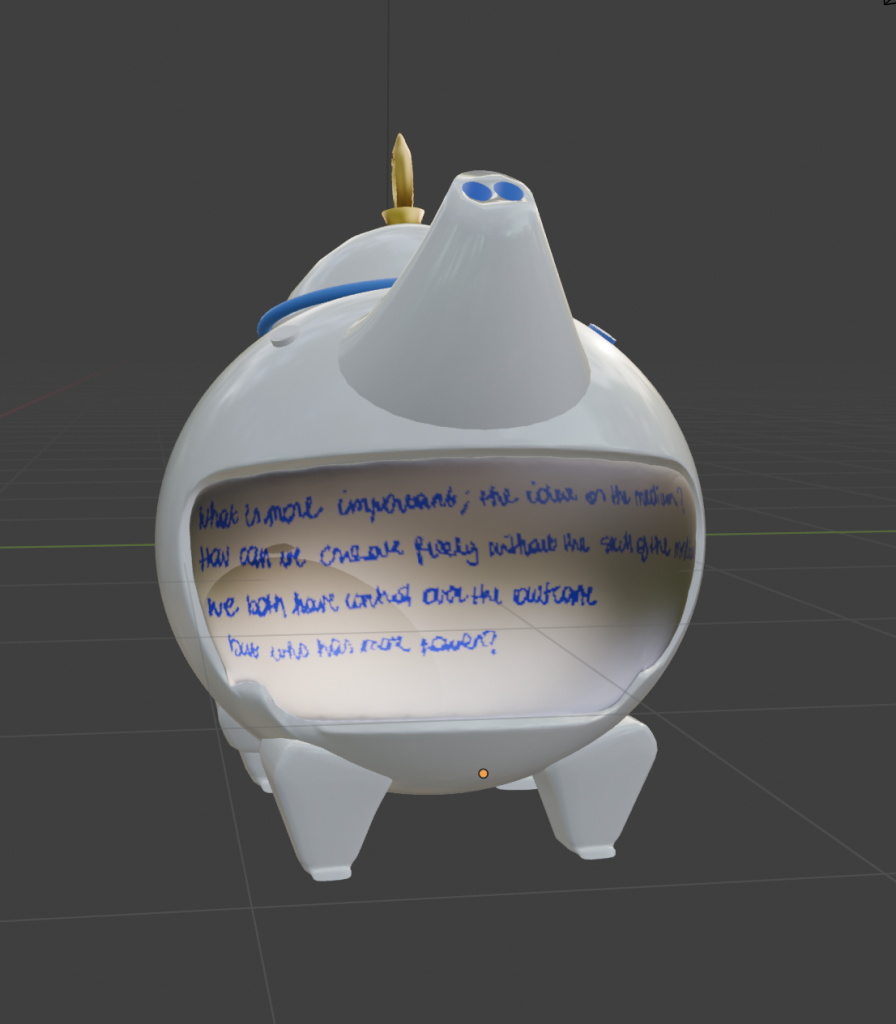
Text rendering:
I chose to write the main idea of my research on my teapot in the software. This way, the handwriting on it reflects the dialogue and duality between analogue and digital. The analogue represents the idea and the digital represents the medium. The text shows the main idea of my research. ‘What is more important: the idea or the medium? How can we create freely without the skill of the medium? We both have control over the outcome, but who has more power?’
Leave a Reply